
Your forehand is fine. Your hips won't let you hit it.
Tennis asks your body to rotate, brake and reach a few thousand times a match. A Future coach trains what's underneath your game, around your court time.
Technique is your pro's job. The body is ours.





Nothing about your technique changes in the third set.
Your strokes are the same ones you had an hour ago. What ran out is the body producing them. That's a training problem, not a coaching-the-forehand problem.
Everything works
- Split step is sharp, you're arriving early
- Full shoulder turn on the forehand
- Serve is landing where you aimed it
The margins go
- Half a step late to the wide ball
- Turn shortens, so the arm starts swinging alone
- First serve percentage quietly drops
You're a different player
- Pushing off flat, no bounce out of the corner
- Reaching instead of stepping, back takes the load
- Points get shortened on purpose because legs are gone
The fix isn't more tennis. It's capacity you build off the court.
Repeat-sprint conditioning that matches how a point is actually played, single-leg strength so the wide ball doesn't cost you two steps, and enough range in your hips and mid-back that the turn survives set three.
A serve starts at the ground. So do most of its problems.
Force travels from the court up through your legs, hips and trunk into the racket. Wherever that chain is stiff or weak, the link above it compensates. Tap through to see where yours is probably leaking.
Where the power for a groundstroke actually comes from.
Tight, weak hips can't rotate or brake, so your lower back and shoulder take over jobs they weren't built for.
Hip rotation range, single-leg strength, and hinge patterning loaded deliberately rather than avoided.
Four tests. Do them before you keep reading.
These are rough versions of what a coach would put you through on day one. Stand up, try each one, and tick the ones that don't go well.
Check the ones you couldn't do cleanly.
Most players over 30 fail at least one of these and have no idea it's showing up in their game.
Two sessions. Around your court time, not on top of it.
The most common objection we hear from players is that they already play three or four times a week. That's the point. Your coach builds the week around when you play and when you compete, and pulls the load back before a match instead of leaving you sore for it.
One example in-season week. Off-season looks different: more volume, heavier, and built to raise your ceiling rather than protect Saturday.
Movement quality is the whole job, not a warm-up.
Certified coaches whose work centers on how well you move: range, control, and the joints a one-sided sport asks the most of. Matched to how you actually play and how often.

Morgan S.
Exercise physiologist, orthopedic clinic background
"Range you can't control isn't range. We load the end of your reach so the shoulder trusts it under a serve."

Rachel H.
Trainer in medical fitness centers, former D1 golfer
"Rotational sports build you crooked. My job is making sure the side you don't hit from can still hold you up."

Kelli P.
Olympic weightlifting and kettlebell coach
"Getting low is a strength problem as often as a flexibility one. Deep positions get loaded, not just stretched."
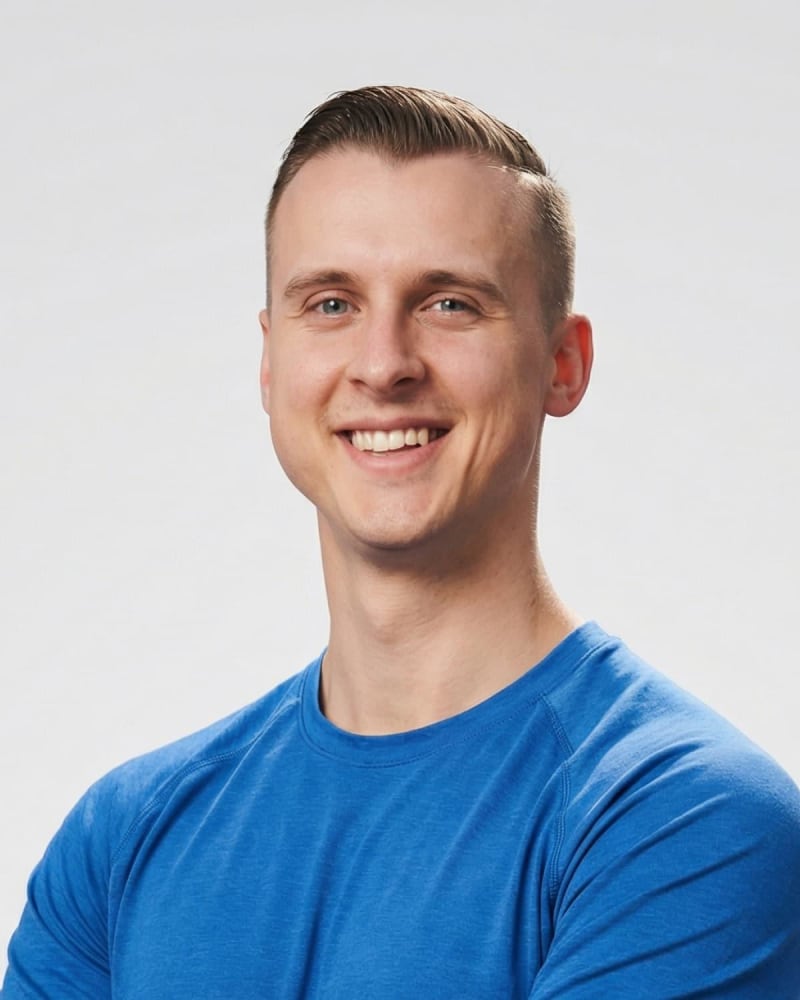
Daniel R.
Sports performance and strength coach
"Third-set legs are a conditioning problem. We build the engine that keeps your feet moving when the match goes long."

Caleb R.
Sports performance coach, adaptive exercise specialist
"Every player shows up with something that pinches. We work around it and build the rest. No waiting until you feel perfect."
The strokes are the easy part.
Nobody quits because their technique got worse. They quit because the body stopped cooperating: the knee, the shoulder, the legs that used to be there at 4-4. Skill you keep for decades. Everything holding it up has to be trained.
Players who stopped blaming the racket.
"I used to shorten points on purpose after an hour. Now the third set is the one I'm winning."
"Turns out my shoulder wasn't the problem. My mid-back hadn't rotated in years. Nobody had ever checked."
"After my ankle, I stopped chasing anything outside the doubles alley. Six weeks of bounding and I trust that leg again."
The part where you talk yourself out of it.

Win the third set with your legs.
Tell us how often you play, what your body has been complaining about, and what's been costing you matches. We'll match you with a coach who builds athletes for a living.