You don't need a new swing. You need the range to make it.

A common benchmark for trunk rotation in movement screens. A desk job quietly takes it away, and your backswing is the first place you notice.
The faults your pro keeps correcting usually start in your body, not your technique.
Most of the faults your pro keeps correcting have a physical version underneath them. A hip that won't turn, a mid-back that's locked, an ankle that won't let you post up.
Your pro owns the swing. We own the body that makes it.
How far do you actually turn?
Sit tall on a chair, cross your arms on your chest, and rotate as far as you can without your hips moving. Drag the dial to roughly what you felt.
Your shoulders stop before your backswing does.
The club reaches the top, but your spine tilts or your lead heel lifts to compensate for the lack of rotation.
Daily thoracic rotation work, hip internal rotation, and breathing drills that free the ribcage. This is the tier that changes fastest.
A rough self-check, not a diagnosis. Your coach screens this properly in week one in both directions, because golfers are almost never symmetrical.
Certified strength and mobility coaches. Not swing instructors.
They won't touch your grip or your takeaway, as that is your pro's territory. They train the range, strength and durability the swing is built on, and they're matched to your body and your schedule.
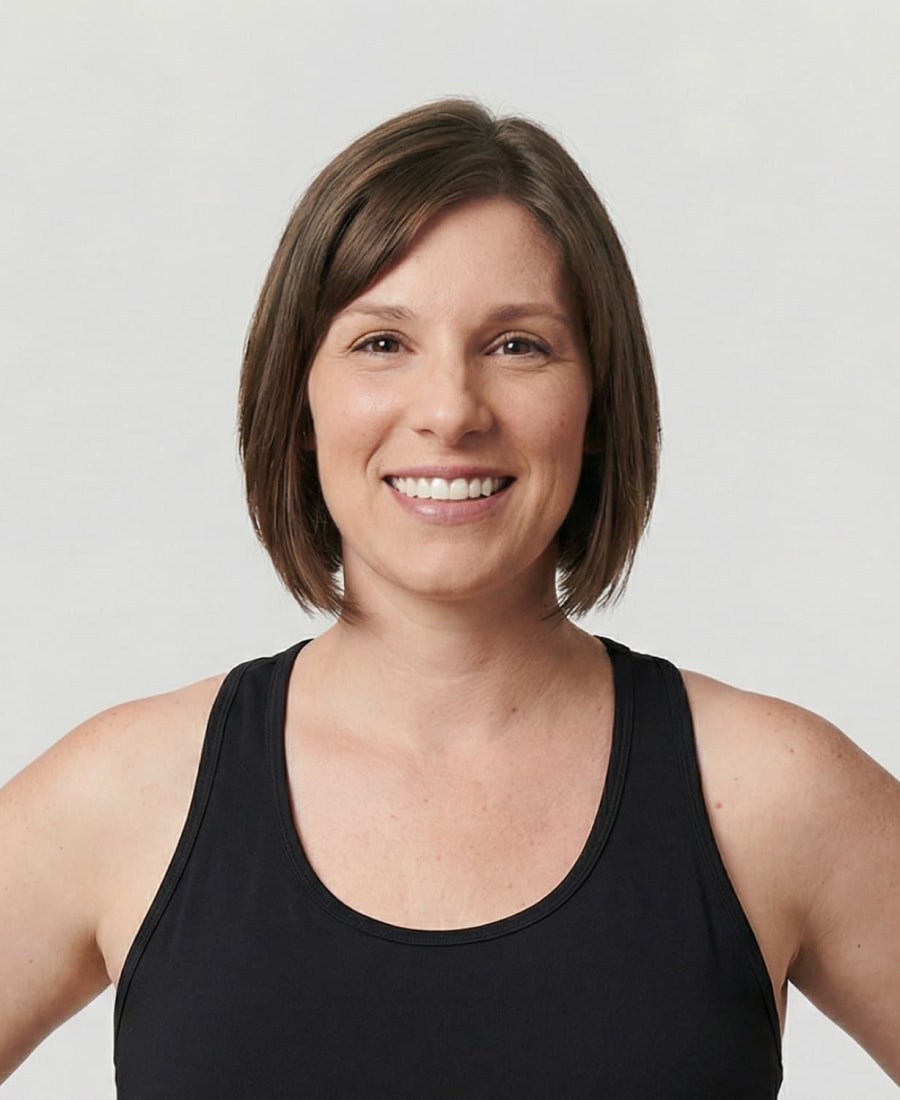
"A rotational sport builds you crooked. One hip loads, one doesn't; one side turns, one fights it. My first job is finding out which of yours is which. Then I make sure the side you don't swing from can still hold you up at the end of a round."
 Morgan S.Exercise physiologist with an orthopedic clinic background
"Range you can't control isn't range. We load the end of your turn so your body trusts it."
Profile Kelli P.Olympic weightlifting and kettlebell coach
"Posting up on the lead leg is a strength problem far more often than a technique one."
Profile Daniel R.Sports performance and strength coach
"Losing your posture by 14 is a capacity issue. We build the engine that holds it to 18."
Profile Caleb R.Sports performance coach and adaptive exercise specialist
"Everyone arrives with something that pinches. We work around it and build the rest."
ProfileFive positions. Each one asks something physical of you.
Your instructor tells you where the club should be. This is what your body has to be able to do to put it there. Step through the swing.
Backswing & top
Rotate the ribcage over a trail hip that stays loaded, while the lower body resists coming along for the ride.
No mid-back rotation and the arms lift instead. No trail-hip internal rotation and the hips slide off the ball. Both feel like 'a big turn' and neither is one.
What twelve weeks of this actually looks like.
Two to three sessions a week, thirty to forty-five minutes, built around when you play. Not a bootcamp, and not the same six exercises forever. The order matters.
Get the range back
Your coach screens you properly first. Both sides are checked, because a golfer's body is never symmetrical. Then short, frequent mobility work aimed at whatever came back restricted, plus easy strength to re-learn hinging and loading a single leg.
- •Daily 10-minute rotation work
- •Hip and ankle range
- •Hinge and split-stance patterning
Setting up to the ball feels less like effort and more like a position you can hold.
Make it strong
Range you can't control under load isn't usable in a swing. This block loads the positions you just opened up, like your trail hip, lead leg, and trunk, so the turn survives contact with the ground and with fatigue.
- •Lower-body strength, single-leg biased
- •Anti-rotation and anti-extension core
- •Loaded carries for posture endurance
The back nine feels like the front nine. Same posture, same contact.
Turn it into speed
Only now does speed work make sense. You can't express power through a joint that doesn't move or a leg that can't hold you. Rotational throws, jumps and landings are all programmed around your tee times so you're never sore for a round that matters.
- •Rotational medicine ball throws
- •Jump and landing work
- •Deceleration and recovery
You're swinging harder without trying to swing harder, and nothing hurts on Monday.
An illustrative progression. Your coach adapts the timeline to your screen, your calendar, and anything that already hurts.
Stretching isn't the plan. It is one line of it.
Most golfers who say they've 'tried mobility' mean they held a few stretches before a round and nothing changed. Range only sticks when you build strength into it. It is a program, not a warm-up, and it's what your coach films, reviews and adjusts every week.
The lessons started working once the body could do them.

"I'd accepted that the back nine was just going to be worse. My pro kept telling me I was standing up out of the shot and I kept trying to fix it with my hands. Six weeks of actual hip and mid-back work and the fault mostly disappeared on its own. Nobody had ever suggested the problem wasn't in my swing."
"Two years of lessons and the same slice. Turns out my mid-back barely rotated. I was making the move my body allowed, not the one I was being taught."
"I used to be done by the 14th. Posture goes, contact goes, the card falls apart. That doesn't happen now, and I didn't change a thing about my swing."
Straight answers.
Will this change my swing?
Not directly, and that's the point. Your coach doesn't touch technique. What usually happens is that a fault your pro has been fighting gets easier to fix once your body can actually make the position. Or it quietly stops happening.
Won't lifting make me tight and slow?
Not the way it's programmed here. Mobility and strength get trained together, and speed work sits on top of both. Tightness usually comes from range you never load, not from lifting.
When does it fit? I already play twice a week.
Two to three sessions of thirty to forty-five minutes, placed around your tee times rather than on top of them. Tell your coach when you play and when you compete, and the week gets built backwards from that.
Do I need a gym?
No. Tell your coach what you have (a full gym, a couple of dumbbells and a band, or nothing but floor space) and the program is written for that.
My back already hurts after a round.
Say so on day one. It's one of the most common things golfers arrive with, and it changes the plan: your coach programs around it, loads it deliberately rather than avoiding it, and flags anything that belongs with a clinician instead.
I'm in season. Is now a bad time to start?
No. In-season just means lower volume and higher intent, with the load pulled back before rounds that matter. The first block is mostly mobility anyway, which is the part that helps immediately.
How is this different from a golf-fitness app?
You get an actual person. A coach who screens you, writes a plan for your body, reviews video of your reps, and changes it every week based on what you're reporting back.
What if it doesn't work for me?
$50 for the first month, then $199/month. Cancel within 30 days for a full refund.
Give the swing a body that can make it.
Tell us how often you play, what your body has been complaining about, and which fault keeps coming back. We'll match you with a coach who builds athletes for a living.